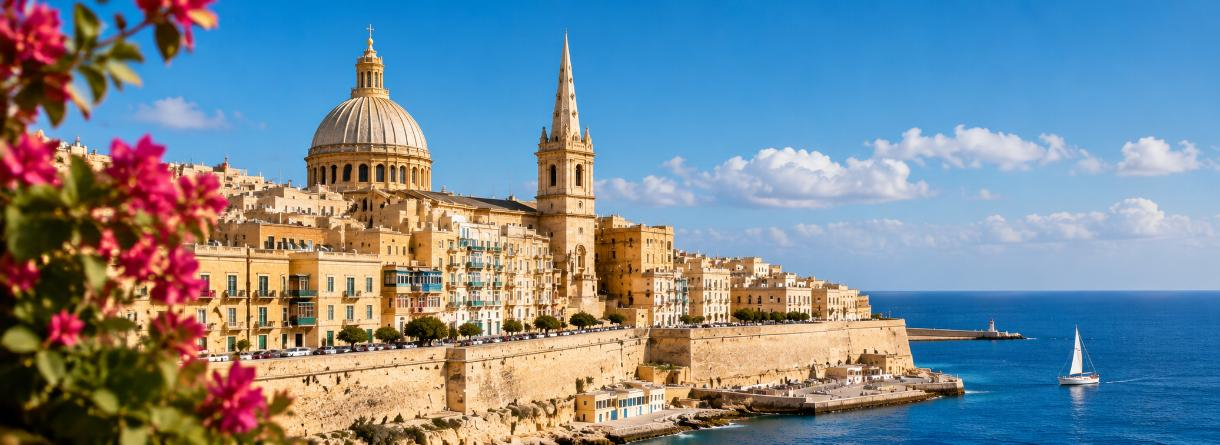
The reform brings together the:
- Global Residence Programme (GRP);
- Residence Programme (RP);
- Malta Retirement Programme (MRP); and
- United Nations Pension Programme (UNPP).
The Conditions
The familiar 15% rate on qualifying foreign-source income remitted to Malta is retained. However, the new framework introduces higher financial thresholds for some applicants, a common property requirement, fixed five-year approval periods and a renewal procedure. Qualifying dependents may now be included, subject to detailed conditions of the rules.
Once the scheme is in force, four ITP categories will be introduced:
- Global Resident Status, principally for non-EU, non-EEA and non-Swiss nationals;
- EU/EEA/Swiss Resident Status;
- Retired Pensioner Status; or
- UN Pensioner Status.
Applications must be made through an Authorised Registered Mandatary and remain subject to due-diligence and fit-and-proper assessment.
Tax treatment and annual minimum tax
The ITP preserves Malta’s remittance-basis approach for qualifying beneficiaries. Foreign-source income received in Malta is taxable at a flat rate of 15%, with double-taxation relief potentially available in accordance with Maltese law. Foreign income that is not remitted to Malta generally falls outside the charge under the programme.
Malta-source income is not covered by the preferential rate and is generally taxable at 35%. The distinction between income and capital gains also remains important: the treatment of foreign capital gains is not the same as that of foreign income and should be reviewed carefully before funds are remitted.
The minimum annual tax depends on the category:
| ITP category | Minimum annual tax |
| Global Resident Status | €35,000 |
| EU/EEA/Swiss Resident Status | €35,000 |
| Retired Pensioner Status | €15,000 |
| UN Pensioner Status | €20,000 |
The minimum is an annual tax liability, not simply a one-off application cost. Applicants should model their expected income, remittances and available double-tax relief before deciding whether the programme is appropriate.
Property and other eligibility requirements
An applicant will generally need to occupy qualifying residential property in Malta as their principal residence. The new common thresholds are:
- a property purchased for at least **€700,000**; or
- a property rented for at least **€14,000 per year**.
Applicants must also maintain suitable health insurance, demonstrate stable and sufficient resources for themselves and their dependants, hold a valid travel document and be able to communicate adequately in one of Malta’s official languages. They must not be domiciled in Malta and must declare that they do not intend to establish a Maltese domicile within five years of applying. Category-specific conditions also apply, particularly to retired and UN pensioners.
Special tax status will initially be granted for five years. It may be renewed for further five-year periods if the beneficiary continues to satisfy the requirements. The published framework also provides for an application fee of €8,500 and a renewal fee of €2,500.
It is important not to confuse special tax status with immigration permission. The tax programme and the legal right to reside in Malta are related but separate questions, and non-EU applicants in particular must ensure that they have the appropriate immigration status.
Transitional period: why 2026 matters
The existing GRP, RP, MRP and UNPP remain available for applications until 31 December 2026. The transitional provisions protect existing beneficiaries and qualifying applications made by the deadline until 31 December 2031, provided the applicable conditions continue to be met. Thereafter, renewal will need to take place under the ITP.
All new applications submitted from 1 January 2027 will fall under the new rules. This creates a genuine planning window during the remainder of 2026. Depending on an individual’s circumstances, applying under an existing programme before the deadline may preserve lower property or minimum-tax thresholds during the transitional period.
How Rosemont Malta can assist
A move should be assessed as part of a complete cross-border plan, covering tax residence in Malta and the country of departure, domicile, treaty access, remittance policy, succession and estate planning, ownership structures, immigration, and ongoing reporting obligations. Rosemont Malta, together with its international network, can help ensure all these aspects are addressed in a coordinated and comprehensive manner.
Rosemont Malta can also assist individuals and families in assessing eligibility under both the existing programmes and the new ITP, comparing the alternatives available before the end of 2026 and coordinating the application through the appropriate authorised professionals.
*This article is intended as a general overview and does not constitute tax or legal advice. Individual advice should be obtained before an application, relocation or remittance is made.*
For further information, please contact: office@rosemont.com.mt
Follow us on LinkedIn and don't miss our updates about Monaco, Malta, Mauritius, and the yachting industry.
Sources
- [Individual Tax Programme Rules, 2026 — Legal Notice 195 of 2026](https://legislation.mt/eli/ln/2026/195/eng)
- [Malta Institute of Taxation: Individual Tax Programme Rules published](https://maintax.org/news/individual-tax-programme-rules-published/)
- [Malta Tax and Customs Administration: taxation of individuals](https://mtca.gov.mt/personal-tax/individual/taxationforindividuals)